Relicensing Was a Skills Problem
A disengaged team of about 30 told leadership the only move left was to relicense a mixed ESXi and vSphere estate. In four weeks, several hundred instances moved to Harvester and Rancher: centralized HCI, fewer people to run it, and Kubernetes beside the VMs, at a fraction of the license cost and the labor.
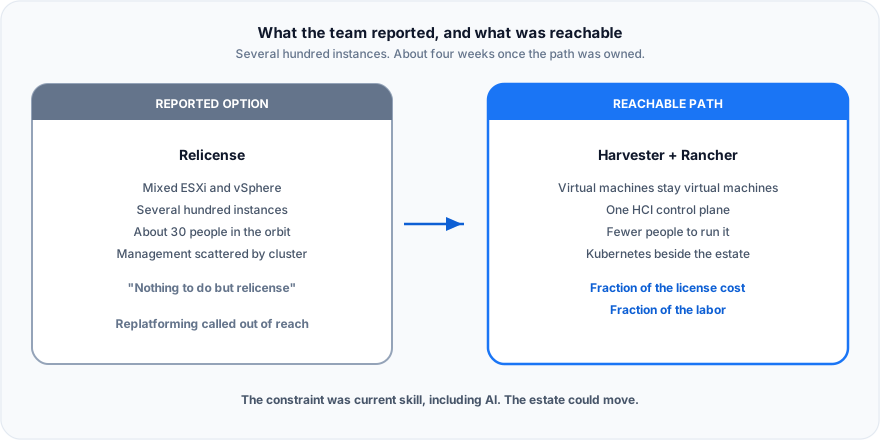
Leadership already had a recommendation. A team of about thirty people, responsible for a mixed estate of ESXi and vSphere, had looked at several hundred instances and reported that there was nothing to do but relicense. Replatforming, in their telling, was out of reach.
The estate moved anyway. In about four weeks those instances were running on Harvester, with Rancher as the management plane. The virtual machines stayed virtual machines. Kubernetes became something the organization could start beside them. Management of the HCI sat in one place. Fewer people were required to run it. License cost and labor both came down to a fraction of the path that had been put in front of leadership.
The useful part is why the first recommendation sounded final, and what those four weeks actually installed.
The Recommendation the Room Heard
The team was disengaged. That is a group that has stopped expecting the system to change, and has started describing that expectation as a technical fact.
They were operating a mix of standalone ESXi and vSphere-managed clusters. The estate had grown the way these estates grow: another host, another cluster, another person who knew one corner of it. About thirty people sat in the orbit of keeping it up. No one held a single operating picture of the whole thing. When leadership asked what came next, the answer that traveled upstairs was relicensing. Renew the agreement. Accept the price. Keep the muscle memory.
That answer has a surface logic. In the current VMware market, a renewal is no longer a quiet procurement event, and a team that has only ever operated one control plane will price every other control plane as a multi-year program. Inside a tired team, a multi-year program is the same sentence as “we cannot.”
So the recommendation arrived dressed as architecture. The hypervisor was the constraint. The skills to leave it were gone. The adult move was to pay and stay.
Why It Sounded Like Architecture
A team that has stopped learning reports the edge of its own practice as the edge of what is possible.
Replatforming was treated as unreachable because the people who would have had to run the next platform had not kept current. The gap was ordinary platform skill: an HCI they could operate, a management plane that showed the whole estate, a migration that did not require a hero for every virtual machine. The gap also included AI. The cost of learning an unfamiliar system, and the cost of executing a repetitive move across hundreds of instances, are both different now than they were when this estate was first built. A team that has absorbed neither change looks at several hundred virtual machines and sees a program it cannot staff.
I argued in Falling Behind Is a Choice that modern capability is more accessible than leaders are usually told, and that the blocker is adoption rather than access. This engagement was that argument with a renewal on the calendar. Harvester and Rancher were available. A forward-looking HCI, with virtual machines and Kubernetes on the same substrate, was available. The team had concluded, from inside its own disengagement, that the exit did not exist. Leadership then received a risk register and heard an architecture review.
Disengagement is specific. It shows up as careful inventories of what might break, and thin inventories of how a move would actually proceed. It shows up as confidence. The people closest to the hypervisor are presumed to know whether an exit is real, and a disengaged team will understate every exit, because the exit requires skills they have let go.
The question worth asking in that room is narrow. Who has operated the alternative recently enough to know whether “unreachable” is true?
What Forward-Looking Meant
The target was a platform the remaining team could run, with the workload they already had.
Harvester is the HCI. It runs the virtual machines the business already depended on, on infrastructure the organization operates without a VMware renewal as the center of the strategy. Rancher is the management plane. One place to see the clusters and the virtual machines, and, when the team is ready, Kubernetes workloads beside those virtual machines.
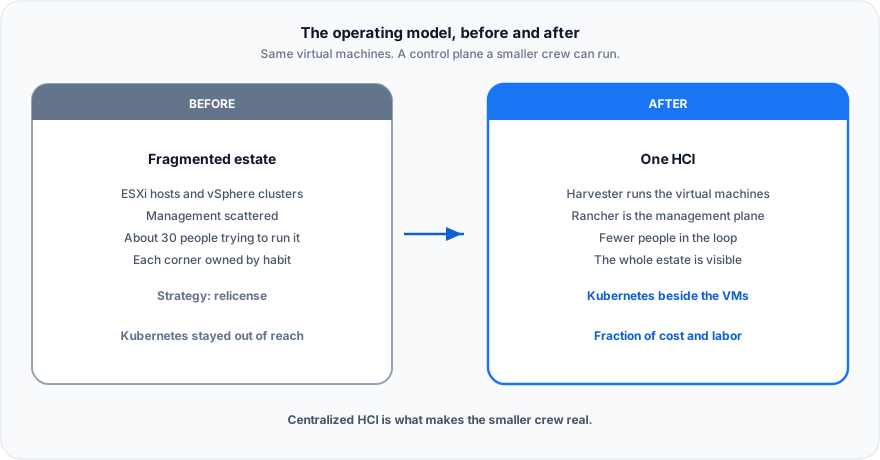
That pairing is the point. The existing estate did not have to be rewritten as containers before anyone was allowed to leave the license. Kubernetes also did not have to wait for a later transformation program. The same substrate holds both. Centralized management is what makes a smaller crew plausible. Thirty people trying to keep a fragmented ESXi and vSphere mix alive is a labor model built around scatter. One HCI control plane is a different labor model.
I have written about a separate engagement in Own Your Destiny, where an organization had already swapped hypervisors and still lacked an operating model. The logo had moved. Day-two clarity had not. This estate had not taken even that step. The team had stopped at the renewal. The work was to leave them with something they could operate on a Tuesday: virtual machines preserved, management centralized, Kubernetes available on the same HCI when they chose to use it.
A cheaper place to put the same confusion would have been a failure. Centralized HCI management was a requirement of the move, because the labor reduction depended on it. If the new platform still needed a person per cluster and a private folklore per host, the headcount would have followed the instances across the migration.
What the Four Weeks Were For
Four weeks is a short time to move several hundred instances. It is enough time once someone current owns the path and the destination is a platform the stayers can run.
The time went to three outcomes.
See the estate plainly. A mix of ESXi and vSphere, several hundred instances, and an operating crew sized to that fragmentation. The relicensing recommendation had been made without a credible picture of an alternative. Once that picture existed, “out of reach” became a claim that could be tested against a real target.
Stand up the target as an operating model. Harvester for the virtual machines. Rancher as the single management plane. Centralized from the start, so the migration landed in a system a smaller group could see and run. A move that only the outsider can operate afterward is a new dependency with a fresher console.
Move the instances. This was the straightforward part. The virtual machines did not need a redesign to change hypervisors. Relative to the story the team had been telling, the migration was easy, because that story had priced a skills gap in as if it were physics. With the path owned by someone who still practiced it, the instances moved.
The scarce ingredient was current judgment. Skills the team had not kept up, including AI, had turned a finite migration into an imagined multi-year program. AI matters here as a change in the cost of learning and of repetitive execution, which is exactly the work a hypervisor exit is made of. A team that has not kept up with that change will honestly believe four weeks is fantasy. Current practice is what makes four weeks a plan.
I could see the path because I already run this shape of system. The Leadership-Grade Homelab keeps Harvester and Rancher under real workloads, including the virtual machines enterprises still have. That practice is what turns “this is reachable” into an operator’s statement.
The $14 million consolidation was a different estate and a different clock: multi-cloud to a single cloud, measured in quarters, with a much larger savings figure. The shared discipline is the operating model on the far side. A migration finishes when the people who remain can run what they just landed on, and when the sequence is short enough that the organization feels the result before the program grows its own staff.
What Changed
The instances landed. Several hundred ESXi and vSphere virtual machines, on Harvester, visible through Rancher.
Management of the HCI was centralized. The organization could stop staffing a fragmented hypervisor estate as if each cluster were its own product. Fewer people were required to keep it running. The labor change was the one the old crew could feel: one control plane, the whole estate visible, a smaller set of people in the operating loop.
The money moved with the labor. Relicensing was the expensive default on the table. The Harvester estate runs at a fraction of that license cost, and the labor to support it is a fraction of what the thirty-person orbit had been spending. Those two move together or the result is incomplete. A cheaper hypervisor that still needs the same crowd is a license win with the old operating model still attached. A smaller team on a platform they cannot operate is a labor win that will unravel at the first incident.
The part the relicensing recommendation could not see is the one that makes the move forward-looking. The same HCI can run modern Kubernetes beside the virtual machines already in production. The organization can start that work on infrastructure it now operates. The VM estate stays where the business needs it, on the platform, while the Kubernetes path opens beside it.
When the Team Says Relicensing Is the Only Option
Treat that sentence as a finding about practice.
Ask who has operated an alternative in the last year. Ask whether the recommendation describes a path or only a list of risks. Ask what the labor model is on the far side, along with the license line on the renewal. A disengaged team will report the boundary of its skills, including the AI-era pace at which a repetitive migration can actually be run. Leadership’s job is to hear that report as information about the team.
Then put a short clock on a real target, and staff it with someone who has already operated that target. The shape of the work — judgment on a platform decision, a few weeks, and a result the remaining team owns — is the engagement model in The Fractional CTO Playbook. The point of these four weeks was the thing left behind: a centralized HCI, a smaller crew, virtual machines still in production, and a Kubernetes path the relicensing conversation had defined out of existence.
If the renewal is the only option on the table, ask whether that is the estate speaking, or the last year of practice.
Staring at a VMware renewal because the team says there is no exit? Connect with me on LinkedIn to talk through whether the constraint is the platform or the skills.
Related insights
The Leadership-Grade Homelab: Why Tech Leaders Need Skin in the Runtime
A production-shaped lab is not a hobby rack—it is deliberate practice that keeps technical judgment calibrated when enterprise stakes are high. Why tech leaders need skin in the runtime.
The Token Bill Is the New Cloud Bill: When Nobody Owns Consumption
AI seats were a project. Agent loops are an operating cost. An executive model for token fat tails, hard-cap rationing, cost per completed owned outcome, and why platform teams—not a monthly invoice—must own the meter.
The Review Bottleneck: When AI Writes Faster Than Humans Can Own the Contract
AI did not remove the human constraint—it moved it from typing to review, and it thinned product ownership of the ask and the outcome. An executive model for review capacity, contract review versus style review, shipping too fast, and when to add gates instead of more senior reviewers.