Falling Behind Is a Choice: AI, Modern Frameworks, and the New Access Reality
Modern AI, cloud-native infrastructure, and production-grade frameworks are more accessible than ever. Leaders who are falling behind are usually facing an adoption problem, not an access problem.
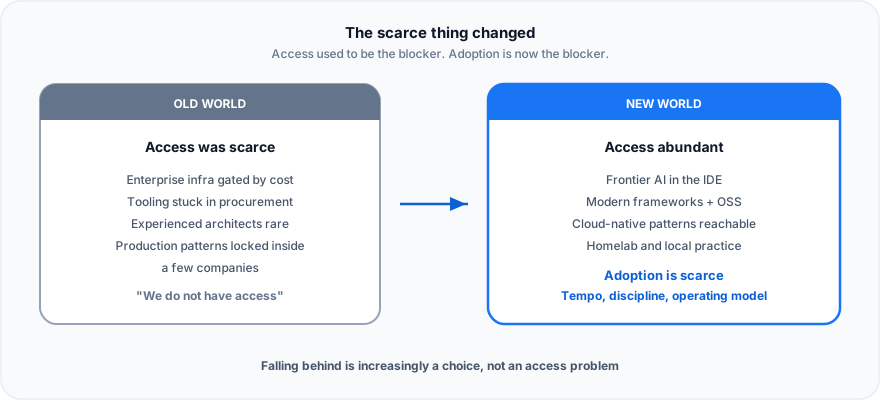
For a long time, falling behind in technology had a believable excuse: access.
Access to enterprise infrastructure was expensive. Access to advanced tooling was gated behind procurement cycles. Access to experienced architects was limited. Access to production-grade patterns required working inside companies that had already built them. Access to learning material was scattered across books, conferences, vendor relationships, and hard-won operational experience.
That world has changed.
The uncomfortable truth for technology leaders in 2026 is that modern capability is no longer locked away the way it used to be. AI assistance, cloud-native infrastructure, modern frameworks, open-source platforms, reference architectures, local development environments, and production-like validation loops are widely available to teams that choose to use them.
That does not mean adoption is easy. It does mean “we do not have access” is becoming a weaker explanation.
If an organization is falling behind now, the blocker is often not the market. It is not the vendor landscape. It is not that the tools are impossible to reach. It is usually leadership tempo, learning discipline, operating model design, and willingness to change how work gets done.
The Access Excuse Is Expiring
AI is the clearest example.
Only a few years ago, advanced AI capability felt remote to most engineering teams. Today, developers can work with frontier models from their IDE, command line, browser, internal tools, APIs, and automated workflows. Product teams can use AI to summarize research, explore requirements, model user journeys, and generate prototypes. Operations teams can use it to investigate incidents, query documentation, draft runbooks, and reason through system behavior.
The same pattern is happening across the rest of the stack.
Modern application frameworks are easier to learn because examples, documentation, and AI-assisted explanations are available instantly. Kubernetes is no longer only the domain of hyperscale companies. Observability stacks, CI/CD systems, authentication patterns, secrets management, service meshes, edge routing, and policy enforcement are all accessible through open-source projects, managed services, and increasingly mature templates.
Even the learning curve has changed. A motivated engineer no longer has to wait for a formal training budget to understand a new framework, compare architectural options, or build a working prototype. AI can accelerate the research loop, explain unfamiliar code, generate first drafts, challenge assumptions, and help translate concepts across stacks.
That shift matters strategically.
The gap between “a team with access” and “a team without access” has narrowed. The gap between “a team willing to learn and operationalize” and “a team waiting for permission” has widened.
Modern Capability Is Reachable From Small Environments
One of the reasons I keep a homelab is that it removes the abstraction from infrastructure conversations. I expand that thesis—and the stack constraints that make practice leadership-grade—in The Leadership-Grade Homelab.
I do not need a giant enterprise program to validate that serious cloud-native patterns are accessible. A small private Kubernetes environment can run real workloads, exercise ingress and certificate automation, test deployment patterns, validate storage behavior, and provide a place to learn production concepts without turning every experiment into a vendor contract or committee decision.
The specifics are not the point. The point is that the same category of capability that once required a large platform team and a long procurement cycle can now be studied, operated, and refined in a contained environment by a disciplined technical leader.
That should change how executives think about adoption.
If one person can build a meaningful learning environment with modern infrastructure patterns, an organization with teams, budget, and business urgency should not still be acting as if these capabilities are unreachable.
The question is not whether every company should run a homelab. Most should not. The question is whether leaders understand how accessible the learning path has become—and whether they still have skin in the runtime when tech debt and vendor decisions come due.
Slow Adoption Creates Its Own Risk
There is a difference between thoughtful adoption and slow adoption.
Thoughtful adoption defines the problem, tests the workflow, manages risk, measures outcomes, and scales what works. Slow adoption waits for certainty, creates committees before experiments, treats every new capability as exceptional, and lets informal usage spread without an operating model.
AI makes this distinction more important because the technology is already inside the organization whether leaders acknowledge it or not.
Engineers are using AI to understand unfamiliar code. Product managers are using it to draft requirements. Analysts are using it to reshape data. Support teams are using it to summarize customer problems. Executives are using it to prepare communication. The real question is not whether AI enters the company. It already has.
The question is whether leadership turns that usage into capability.
Without an adoption model, the organization gets the worst combination: scattered experimentation, uneven quality, hidden risk, and no repeatable learning. People use modern tools, but the company does not become modern.
That is how organizations fall behind while still buying the same tools as everyone else.
Framework Access Is Not Framework Competence
Modern frameworks create a similar trap.
It is easy to start a new application with Svelte, React, Astro, Go, Rust, Python, Kubernetes, Terraform, or whatever stack is appropriate for the problem. The first working demo is no longer the hard part. AI can help generate scaffolding, explain unfamiliar syntax, wire common patterns, and accelerate the early build.
But framework access is not framework competence.
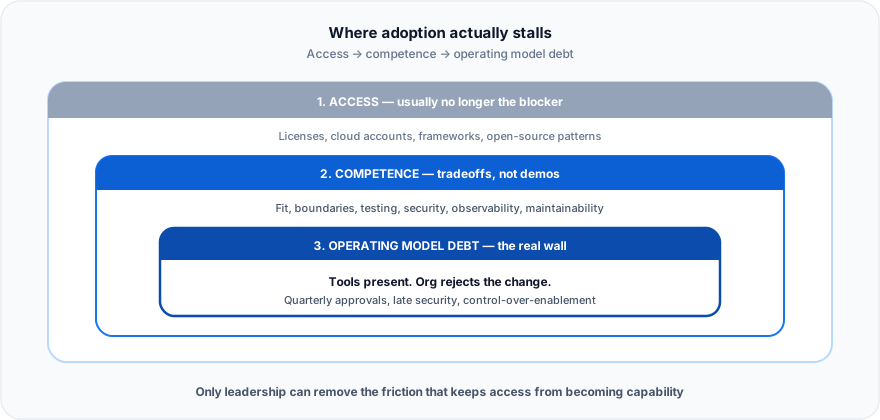
Competence comes from understanding the tradeoffs:
- where the framework fits and where it does not
- how state, data, and boundaries should be modeled
- how the system will be tested and deployed
- how the team will maintain it after the excitement fades
- how security, observability, and performance will be handled
- how the architecture supports the business over time
This is where leadership still matters. AI lowers the cost of starting. It does not remove the need for technical judgment.
The organizations that win are not the ones chasing every framework announcement. They are the ones that build a learning engine: evaluate quickly, prototype honestly, adopt deliberately, and retire old assumptions when the evidence changes.
The Real Blocker Is Often Operating Model Debt
When leaders say they are blocked from adopting AI or modern engineering practices, I usually look for operating model debt.
Common symptoms include:
- approval processes designed for quarterly change, not weekly learning
- architecture review boards that critique after decisions are already frozen
- platform teams measured by control instead of enablement
- security processes that arrive too late to shape the workflow
- procurement models that treat every experiment like a permanent enterprise commitment
- delivery metrics that reward output while ignoring learning velocity
- senior engineers overloaded as manual quality gates instead of system designers
None of those are technology access problems.
They are organizational design problems.
A company can have AI licenses, modern cloud accounts, Kubernetes clusters, framework standards, and approved vendors while still being structurally too slow to benefit from them. The tools are present. The operating model rejects the change.
That is why adoption needs executive attention. Not because executives should pick every tool, but because only leadership can remove the organizational friction that keeps accessible capability from becoming real capability.
What Leaders Should Do Instead
The answer is not reckless adoption. It is disciplined acceleration.
Start with real workflows, not abstract tool enthusiasm. Pick a recurring problem where modern capability should change the economics: incident investigation, legacy modernization, product prototyping, test generation, internal documentation, platform self-service, cloud cost analysis, or customer support triage.
Then design the adoption path:
- Define the workflow. What task should become faster, safer, cheaper, or more repeatable?
- Package the context. What code, docs, standards, data, and constraints does the tool need?
- Expose safe tools. What systems can the workflow inspect or change, and under what approval?
- Set validation gates. What tests, reviews, policies, and measurements prove the result is trustworthy?
- Measure outcome economics. Did lead time improve? Did failure rate stay controlled? Did review burden decrease? Did quality improve?
- Make the pattern reusable. Can a second team follow the same workflow without relying on one power user?
That is how access becomes capability.
The same pattern applies to modern frameworks and infrastructure. Do not just let one motivated team build something impressive in isolation. Capture the patterns. Document the tradeoffs. Create starter templates. Build local development paths. Define production expectations. Make the next team faster because the first team learned in public.
The Choice Leaders Have to Make
The uncomfortable message is this: falling behind is increasingly a choice.
It may not feel like a choice inside the organization. It may feel like budget pressure, talent constraints, compliance complexity, legacy systems, vendor lock-in, roadmap pressure, or change fatigue.
Those constraints are real. But they are not unique.
Every serious organization has constraints. The difference is whether leadership uses those constraints as design inputs or as excuses to defer learning.
Modern technical capability is more accessible than it has ever been. AI can accelerate learning. Frameworks are easier to explore. Infrastructure patterns can be practiced outside massive enterprise programs. Open-source ecosystems provide working examples. Managed services reduce setup cost. Local and private environments make experimentation safer. The hard part is no longer finding the front door.
The hard part is walking through it with discipline.
Conclusion
Technology leaders do not need to chase every trend. They do need to recognize when the access landscape has changed.
AI, modern frameworks, and cloud-native infrastructure have lowered the cost of learning and experimentation dramatically. That does not make every decision easy, but it does remove many of the old excuses.
If your organization is behind, ask a sharper question than “Which tool should we buy?”
Ask what your operating model makes hard that the modern technology landscape has already made accessible.
That is where the real work begins.
Trying to turn AI, modern frameworks, or cloud-native platforms into practical operating capability instead of scattered experimentation? Connect with me on LinkedIn to discuss adoption strategy and execution.
Related insights
Agent Sprawl Is the New Shadow IT: Why AI Adoption Needs Platform Engineering
Agentic AI is moving from pilots into production workflows, creating a new form of shadow IT. Technical leaders need platform engineering discipline to manage AI agents with governance, context standards, validation, observability, and cost control.
From Concept to Cloud: Building Enterprise Software at AI Speed
How AI-augmented development with expert leadership enabled building a cloud-native Git platform with enterprise features in record time.
The Token Bill Is the New Cloud Bill: When Nobody Owns Consumption
AI seats were a project. Agent loops are an operating cost. An executive model for token fat tails, hard-cap rationing, cost per completed owned outcome, and why platform teams—not a monthly invoice—must own the meter.