The Leadership-Grade Homelab: Why Tech Leaders Need Skin in the Runtime
A production-shaped lab is not a hobby rack—it is deliberate practice that keeps technical judgment calibrated when enterprise stakes are high. Why tech leaders need skin in the runtime.
A surprising number of technology leaders can narrate a platform strategy fluently and still cannot interrogate a runtime honestly. They know the slide. They know the vendor. They know the quarterly narrative. What they do not know—in their hands—is how the system behaves when restore fails, when Windows still matters, when GitOps drifts, or when a “simple” framework choice collapses under day-two load.
That gap is not about IQ. It is about practice.
I keep a leadership-grade homelab for the same reason elite operators keep drills: judgment decays when it is only exercised against decks. Abstraction without skin in the runtime produces vendors, status meetings, and brittle decisions dressed up as strategy. A lab will not replace leading a $14M migration. It will keep the muscles that make that kind of leadership honest. The AI-runtime sibling is spinning up a local AI lab: inference you own, agents you pin, adapters you promote only when an eval says so.

Falling Behind Is Often a Practice Gap
I argued in Falling Behind Is a Choice that modern capability is more accessible than leaders admit. AI tools, cloud-native patterns, and production-grade frameworks are no longer locked behind hyperscale budgets. If an organization is behind now, the blocker is usually leadership tempo and learning discipline—not access.
A homelab makes that argument concrete. You do not need an enterprise procurement cycle to validate ingress, certificates, stateful storage, multi-cluster blast radius, or a GitOps promotion path. You need constraints, curiosity, and the willingness to be wrong in a place where being wrong teaches instead of bills the company.
Most companies should not run a homelab as policy. Leaders should understand how short the path to production-shaped practice has become—and whether anyone on the leadership team still has skin in the runtime when vendor renewals and tech debt come due.
What a Leadership-Grade Lab Actually Is
A leadership-grade lab is not a shopping list. It is a set of constraints that force the same kinds of decisions production forces:
- VMs you control, including workloads that still look like Windows
- More than one environment, so blast radius is real
- GitOps over click-ops, so change has a paper trail and a rollback story
- Observability you actually use when something breaks at 11 p.m.
- Stateful data, not only stateless demos that restart cleanly forever
- At least one system that hurts when you are wrong—telephony, sync correctness, restore drills
That is the ownership gym. I keep a multi-cluster, GitOps-driven environment for the same reason I keep shipping owned products: decision skills and trench skills stay calibrated when the stakes are personal before they are enterprise-scale.
Windows did not get the memo about “containers only.” Many estates still need Windows Server images, drivers, sysprep-style preparation, and a place to land. Leaders who only practice Linux containers green-light brittle exits. Boring is where production lives. A serious practice environment still includes boring.
Selective Stack Proof—Not a BOM
Here is enough architecture to make the constraints real—not a rack tour.
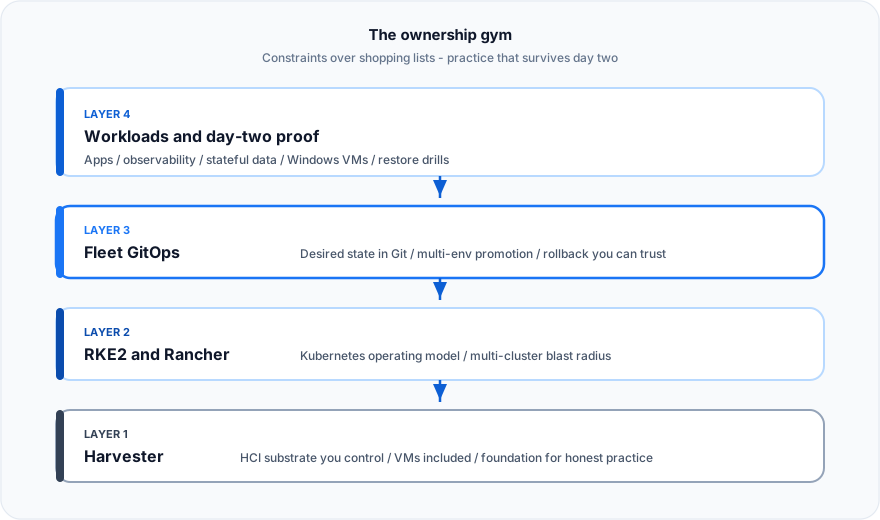
Harvester gives me a hypervisor and HCI-shaped substrate I control. RKE2 and Rancher provide the Kubernetes operating model I actually advise on in larger programs. Fleet keeps promotion GitOps-driven instead of click-driven. On top sit real workloads, observability, and stateful services—PostgreSQL-shaped persistence, object storage, the kinds of dependencies that punish sloppy day-two thinking.
The point is not that every leader must run this exact stack. The point is that the stack encodes constraints: multi-cluster reality, Git as source of truth, observability under failure, and a path that still admits VMs. When I later help an organization recover from a hasty Proxmox logo-swap that left observability thin and control-plane confidence weak, the muscle memory is the same: install an operating model, not just a new platform. Portability and restore become first-class. Simplicity for the people who run the system becomes a requirement.
A leadership-grade lab is how you rehearse that without turning every experiment into a committee.
Frameworks as Practiced Judgment
“Frameworks” here means two layers that leaders often treat as separate hobbies: the infrastructure operating model, and the application frameworks you claim to understand.
Infra frameworks under honest pressure
GitOps with Fleet is not a checkbox. It is a habit: desired state in Git, promotion between environments, blast radius you can see, rollback you can trust. Kubernetes is not a keyword—it is an operating model with admission, scheduling, storage, and failure modes. Validation harnesses matter more than architecture diagrams.
QuikSync made that visceral. Sync has to be right across real operating systems—not a demo on one laptop. The validation bed on Harvester brings up Linux and Windows Server VMs, plus MinIO and NFS, orchestrated from a Mac. One command runs the loop: build, stand up the bed, provision peers, run scenario packs, report, tear down. That loop caught an NFS protocol mistake that only appeared against a real nfs-kernel-server. Unit tests never would have. That is what practiced judgment looks like: own the product, own the proof.
App frameworks learned under load
Access to Svelte, Go, React, Rust, or Kubernetes is not competence. Competence is knowing where the framework fits, how state and boundaries should be modeled, how the system is tested and deployed, and how the team will maintain it after the excitement fades. Leaders who only consume frameworks through conference talks hire for fashion. Leaders who practice them under load hire for judgment.
I practice that on products I own:
- QuikGit — Svelte 5, Go, PostgreSQL, Redis, MinIO, Kubernetes with Fleet/Rancher. A cloud-native Git platform built end-to-end so the AI-accelerated middle still sits inside architecture judgment.
- QuikPBX — telephony-shaped reality: WebRTC, SIP, IVR, trunks you can swap. A system that hurts when media paths or failover stories are wrong.
- QuikSync — FastCDC, SSH, QUIC, multi-OS correctness. Proof that “it works on my laptop” is not a release strategy.

This is adjacent to how small end-to-end teams should work: local parity, production-confidence gates, ownership of the whole experience. The lab is personal practice of that model. The advisory application is organizational.
AI makes scaffolding cheap. It does not make day-two judgment optional. That is the same discipline behind avoiding cognitive debt: humans keep intent, boundaries, invariants, and outcomes.
Why It Matters If You Lead Technology
A lab will not ship your enterprise roadmap. It will change how you lead the people who do.
Vendor interrogation gets sharper. You stop comparing decks and start asking about restore paths, Windows-shaped workloads, upgrade blast radius, and what happens when the control plane lies. Leaders who have operated a runtime smell theater faster. Procurement still matters. So does the ability to tell when a proposal is solving a real operating problem versus selling a new logo for an old failure mode.
Restore literacy becomes non-negotiable. Theoretical DR is a bedtime story. Leaders who have restored stateful services under their own constraints ask better questions in diligence and in incident reviews. Boards do not need you to run every restore personally. They need you to know when “we have backups” is not the same sentence as “we have recovered.” See also how ownership changes buy-versus-build math in Own Your Destiny.
AI and tool evaluation get a feedback loop. Judging AI from the vibe-slop era—or from a keynote—is how organizations buy licenses and stall. Leaders who still ship with modern tools know when the cliff flipped and when the middle still needs human ownership. I wrote about that tooling shift in The AI Workflow Revolution. A lab turns AI from a slogan into a practiced middle layer with verification attached.
Mentoring credibility compounds. Teams trust leaders who can still talk about failure modes without outsourcing every hard question to a partner on the call. Practice is not about doing the IC work forever. It is about not losing the ability to recognize good work—and to coach the next person who will own it.
Platform decisions get faster—and safer. Pattern recognition from a production-shaped lab transfers into platform engineering conversations: golden paths, self-service with guardrails, and operating models that outlive any single vendor logo. Speed without practiced judgment is just expensive thrash. Practiced judgment makes speed legitimate.
None of this claims the lab is the $14M program. It claims the judgment that survives those programs is perishable—and practice is how you keep it. Inspiring teams is easier when leadership can still point at reality, not only at a roadmap.
What Not to Do

Homelab as gear theater. If the rack is a status symbol and nothing hurts when you are wrong, you built a museum. Constraints beat capacity.
Endless framework hopping. Chasing every announcement is the opposite of practiced judgment. Evaluate quickly, adopt deliberately, retire assumptions when evidence changes.
Treating lab success as enterprise strategy. A clean personal GitOps loop is not a transformation program. It is rehearsal. Organizations still need operating models, team design, and executive attention to friction—the themes in platform ROI and agent sprawl governance.
Skipping restore and DR drills. If you never restore, you do not own the data story. Stateful practice without restore practice is cosplay.
Leadership Checklist
Answer these without a slide:
- When did you last personally operate a failure, restore, or multi-environment promotion—not watch one?
- Can you explain your preferred platform’s blast radius and rollback path without a partner on the call?
- Where do Windows-shaped or VM-shaped workloads land in your mental model—or did containers erase them from the story?
- Which frameworks has your leadership team practiced under load versus admired in demos?
- If AI compressed the build middle tomorrow, who still owns validation, invariants, and day-two operations?
- Is anyone on the leadership team keeping trench skills current on purpose—or has practice become someone else’s job?
If those answers are fuzzy, you do not have a tooling gap. You have a practice gap.
Keep the Judgment Current
Destiny is owned by people who can still run and ship—and by leaders who keep that judgment current. A leadership-grade homelab is one of the cheapest, most honest ways to do it.
You do not need my stack. You need constraints that punish shallow confidence: more than one environment, GitOps over click-ops, observability under failure, stateful data, and at least one system that hurts when you are wrong. Practice there. Lead everywhere else with sharper questions.
This is the piece the book took its name from. Skin in the Runtime carries the argument through review capacity, cognitive debt, measurement, and agent governance, with a leadership checklist at the end of each chapter. If you would rather start with a conversation than a lab, get in touch.
I take on selective fractional and advisory work where platform, cloud, and AI-stakes decisions need battle-tested judgment. For how that engagement model works when it is scoped for leverage, see The Fractional CTO Playbook.
Building a practice environment—or trying to restore leadership judgment that drifted into pure abstraction? Connect with me on LinkedIn to continue the conversation.
Related insights
Own Your Destiny: Why AI Makes Vendor Default Obsolete
There is no better time to tackle tech debt and vendor decisions. AI and open platforms are making rented SaaS and contracted code optional again—if leadership still has skin in the runtime.
One Brain on the Desk: Strix Halo, Flash-Next, and OpenCode Web
A simple non-cloud coding setup that finishes real work: one Flash-Next model on a Strix Halo class machine, an OpenAI-compatible API, and OpenCode Web. Measured throughput, the hardware constraints that matter, and a short howto.
Spinning Up a Local AI Lab: OpenCode, llama.cpp, and LoRA
A howto for a working local AI lab: one llama.cpp router serving specialist models, OpenCode as the control plane, and LoRA when an adapter earns a slot. Practice for owning the harness—not a chatbot toy.