Cognitive Debt: What Teams Must Still Understand When AI Writes the Middle
Teams do not need to know every implementation detail when AI is a competent middle-layer partner. Cognitive debt is losing the durable high-level model—intent, boundaries, invariants, and failure modes—required to direct that partner and intervene when it is wrong.
Leaders are worried that nobody understands the codebase anymore.
In 2026 surveys of engineering leaders, that anxiety shows up clearly: a large share of production code is now AI-generated, and many leaders say they are concerned about losing shared understanding of their own systems. The emotional register is familiar—excited and anxious in the same breath.
Sometimes that worry is pointing at the wrong thing.
In practice, teams often should not try to know every implementation detail. If AI is a competent partner for labor-intensive middle work, high-level intent and verified outcomes can be enough. That is not negligence. It is the same abstraction bargain software has always made with compilers, frameworks, and cloud APIs.
Cognitive debt is not “humans stopped reading every line.” That is progress.
Cognitive debt is when the team loses the durable high-level model required to direct the partner, judge outputs, and intervene when the middle layer is wrong: purpose, boundaries, invariants, failure modes, and ownership of outcomes.
You do not need to know the details. You do need to own the contract with the middle—and keep enough system understanding to renegotiate that contract under pressure.
The Abstraction Bargain Is Real
Software has always been layered. Nobody debugs machine code for every feature. Nobody insists that every engineer can reconstruct the internals of the database, the TLS stack, or the Kubernetes scheduler before they ship a product change. We accept competent middle layers because the alternative does not scale.
AI is becoming another middle layer.
Used well, it can own boilerplate, glue, refactors, test scaffolding, exploratory implementation, and a large share of the mechanical work between a clear request and a verifiable result. The operating loop looks like this:
- Humans define intent and constraints.
- AI generates and iterates in the middle.
- Humans and systems verify outcomes.
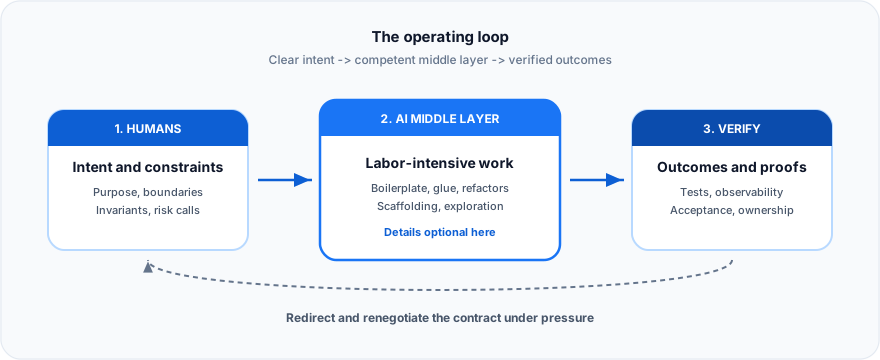
That loop can be a valid operating model. Demanding full line-level comprehension of every AI-authored change can be nostalgia dressed as rigor. It also does not scale once agents are producing a meaningful share of merged work.
I have seen AI help build serious systems quickly when it is directed by domain expertise, structured workflows, and quality oversight—the pattern behind building enterprise software at AI speed. The point of that work was never that humans typed every line. The point was that humans owned direction, architecture judgment, and the definition of done.
So the question is not “does the team understand every file?” The question is “does the team still own the model that makes the partnership safe?”
Rename the Risk
If cognitive debt meant “someone else wrote the code,” every organization that uses open source, generated clients, or managed services would already be bankrupt. That definition is useless.
A better definition:
Cognitive debt is the gap between what the system does and what the team can still explain, constrain, and change at the contract layer—without depending on one hero engineer or one lucky agent session.
The durable model includes:
- Intent. Why this system exists and what outcomes it must produce.
- Boundaries. What is in scope, what is out of scope, and which interfaces are load-bearing.
- Invariants. What must remain true even when implementation changes.
- Failure modes. How the system breaks, how you detect it, and who responds.
- Ownership. Who is accountable for the outcome when the middle layer is wrong.
Line-level familiarity is optional for many surfaces. Those five are not.
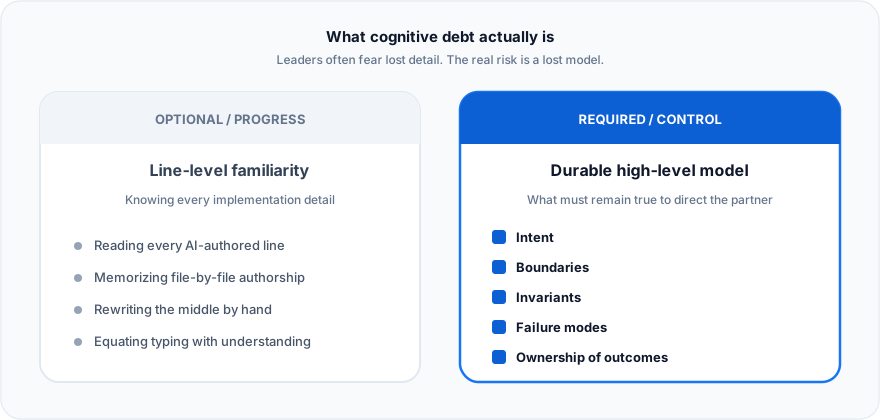
This is also why the common fear—“we are losing shared understanding of the codebase”—is often mis-aimed. Leaders fear lost detail when the real risk is a lost model. Detail can be regenerated. A shared model cannot, at least not cheaply, once it has dissolved into tribal memory and private agent sessions.
That distinction matters for measurement too. In Measuring AI-Assisted Engineering, I argued that license counts and AI-generated lines of code do not prove adoption is working. The same logic applies here. “Percentage of code written by AI” tells you almost nothing about whether the team still owns the contracts that make that code trustworthy.
Where the Partnership Fails
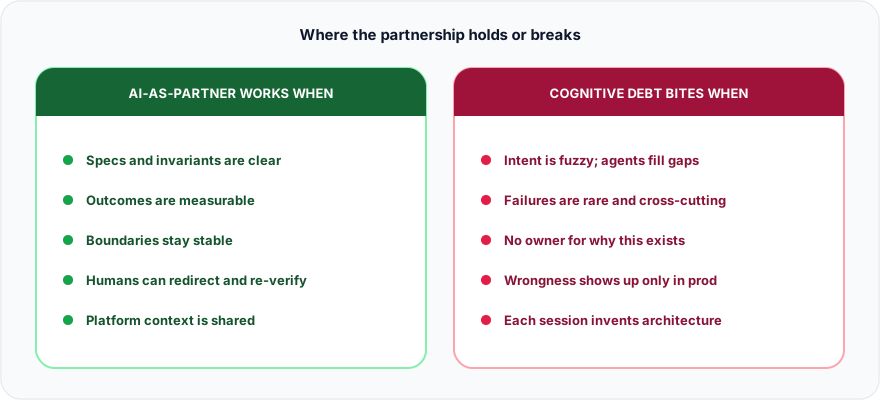
AI-as-partner works when specs and invariants are clear, outcomes are measurable, boundaries are stable, humans can redirect and re-verify, and platform context is shared.
Cognitive debt bites when those conditions erode.
Fuzzy intent, silent gap-filling
Agents are excellent at filling ambiguity. That is useful in a prototype. It is dangerous in a production system. If the team cannot state the intended behavior crisply, the middle layer invents a behavior that “looks right.” The PR merges. The model of the system quietly drifts.
Architectural drift without ownership of “why”
AI can produce locally coherent changes that are globally incoherent. A new caching layer here. A second auth path there. A convenience abstraction that duplicates an existing one. None of those diffs look catastrophic in isolation. Together they create a system nobody meant to design.
Unverifiable outcomes
If you cannot observe whether the change worked—through tests, metrics, traces, or explicit acceptance checks—then “competent partner” becomes an article of faith. Trust without verification is not partnership. It is hope.
“Looks right” review
Review that only asks whether the code is tidy is the wrong ritual for an AI-authored middle layer. The useful review questions are about intent, invariants, failure modes, and blast radius. Authorship purity is irrelevant. Contract integrity is not.
Onboarding that teaches tools, not contracts
New engineers learn which assistant to use, which prompts are popular, and which repos to open. They do not learn the system’s boundaries, invariants, or incident shape. The organization then confuses tool fluency with system fluency.
Incidents that require reasoning the team no longer has
This is where cognitive debt becomes expensive. Rare, subtle, cross-cutting failures still require humans who can reason about the system under pressure. If the only people who can do that left—or never existed because the model was never maintained—you discover the debt at the worst possible time.
This is adjacent to the problem in Agent Sprawl Is the New Shadow IT: unmanaged agentic work creates capability theater. Here the failure mode is slightly different. Even with approved tools, you can still lose the shared model that makes those tools safe to use at scale.
Division of Cognitive Labor
The useful leadership move is not “make humans read more code.” It is to assign cognitive labor deliberately.
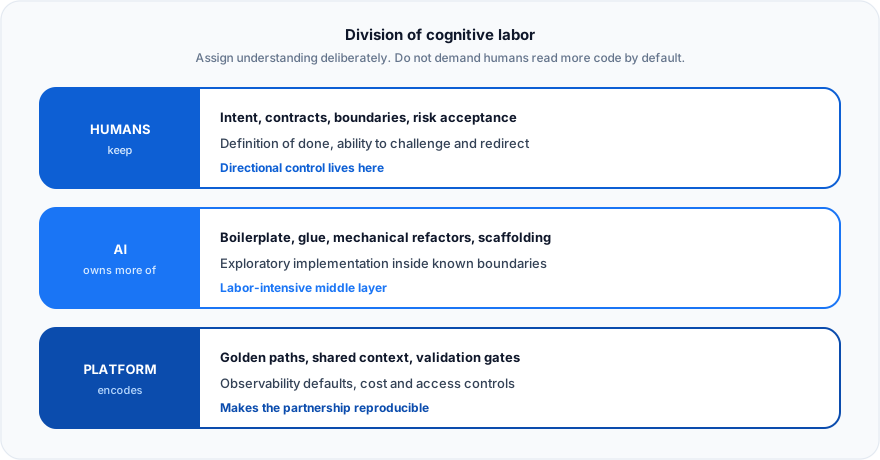
Humans should keep:
- Problem definition and product intent
- System contracts and architectural boundaries
- Risk acceptance and tradeoff decisions
- Definition of done, including security and reliability constraints
- The ability to challenge and redirect the middle layer
AI should own more of:
- Boilerplate and glue
- Mechanical refactors
- Test and fixture scaffolding
- Exploratory implementation inside known boundaries
- First-pass documentation and change summaries that humans still validate
The platform should encode:
- Golden paths and approved workflows
- Shared context packages so agents inherit the model instead of inventing one
- Validation gates, policy checks, and observability defaults
- Cost and access controls that keep the partnership reproducible
That last layer is the connection to LLMs Are Becoming a Commodity. Durable advantage is not the branded client. It is the workflow, context, validation, and operating discipline that make a competent middle layer behave like part of your system rather than a freelance contributor with amnesia.
Executive Tests That Actually Matter
Stop asking whether every engineer can explain every PR line by line. Ask these instead.
Can the team state the system’s contracts and invariants without opening the IDE?
If the answer depends on one senior engineer’s memory, you do not have a shared model. You have a key-person dependency with better tooling.
Can they detect when an agent violated those contracts?
Competence in the middle layer is not assumed. It is checked. If violations are only discovered in production, your verification loop is too late.
Can they change direction and have the middle layer follow?
New regulatory constraint. New latency budget. New failure mode. New data boundary. If the team cannot update the contract and get consistent agent behavior afterward, they are passengers, not directors.
If the strongest AI-enabled engineer left tomorrow, would the model survive—or only the generated code?
Code without a transferable model is inventory. Capability is the ability to keep directing, verifying, and evolving the system.
These tests also matter in diligence. In Technical Due Diligence for Acquirers and Boards, the useful question is not who typed the code. It is whether the organization can explain, operate, and change what it ships. Cognitive debt is an acquisition risk precisely because generated volume can look like progress while directional control is already gone.
An Operating Model That Does Not Become Bureaucracy
You do not need a new committee. You need a few durable habits.
Maintain the contract layer, not a novel
Keep living system models and architecture decision records at the level of intent, boundaries, and invariants. Short beats comprehensive. A stale hundred-page wiki is not a shared model. A current one-page contract for each critical surface is.
Review for contracts, not authorship
Change review standards so the default questions are:
- What intent does this change serve?
- Which invariants must still hold?
- What failure modes does this introduce or remove?
- How will we know in production if this is wrong?
Do not grade PRs on whether a human “could have written it.” Grade them on whether the team can still own the outcome. For the queue, staffing, and product-ownership problem that follows, see The Review Bottleneck.
Prefer outcome and observability proofs over ritual code reading
For many changes, strong tests, typed contracts, canaries, traces, and explicit acceptance checks beat performative line-by-line reading. Read deeply where the blast radius is high. Elsewhere, verify the contract.
Encode the model in the platform
If every agent session starts from a blank chat, you will get private architectures. Put context, golden paths, and validation into the platform so the middle layer inherits the organization’s model. That is how AI adoption becomes capability instead of heroics.
Drill comprehension on critical paths
Schedule walkthroughs and “explain this path” sessions for incident-prone surfaces, security boundaries, money paths, and migration seams. Do not demand the same ritual for every CRUD handler. Cognitive investment should follow risk.
What Not to Do
The failure modes are predictable.
- Ban AI. That does not restore understanding. It restores slower delivery and a false sense of control.
- Fetishize “I wrote it.” Authorship is not comprehension, and comprehension is not ownership of outcomes.
- Measure percentage of AI-generated code. Volume is not directional control.
- Demand humans rewrite the middle. That burns the leverage. Direct and verify instead.
- Confuse documentation volume with a shared model. Unread docs are not understanding. Current contracts are.
Falling behind on AI is still a choice, as I argued in Falling Behind Is a Choice. The opposite mistake is also a choice: adopting so quickly that the organization can no longer steer.
Conclusion
The winners will not be the teams that memorize implementations. They will be the teams that keep a sharp high-level model and treat AI as a competent partner inside clear contracts.
That is the real division of labor. Humans own intent, boundaries, invariants, failure modes, and outcomes. AI owns more of the labor-intensive middle. The platform makes the partnership repeatable.
Cognitive debt is what happens when leaders confuse those layers—either by clinging to line-level nostalgia or by surrendering the model entirely and hoping the middle layer remains lucky.
You do not need to know the details. You do need to know what must remain true, how you will detect when it is not, and who is accountable when the partner is wrong.
Cognitive debt is one of the core chapters in Skin in the Runtime. Cognitive Debt is the audit: what to hold, how to check one surface, and a ninety-day paydown.
See what’s inside Cognitive Debt · Get the paperback on Amazon
Reading it with a team? Ask about copies and a facilitator guide. Run explain / operate / change after the readers have the book.
Related insights
The Token Bill Is the New Cloud Bill: When Nobody Owns Consumption
AI seats were a project. Agent loops are an operating cost. An executive model for token fat tails, hard-cap rationing, cost per completed owned outcome, and why platform teams—not a monthly invoice—must own the meter.
The Review Bottleneck: When AI Writes Faster Than Humans Can Own the Contract
AI did not remove the human constraint—it moved it from typing to review, and it thinned product ownership of the ask and the outcome. An executive model for review capacity, contract review versus style review, shipping too fast, and when to add gates instead of more senior reviewers.
The Leadership-Grade Homelab: Why Tech Leaders Need Skin in the Runtime
A production-shaped lab is not a hobby rack—it is deliberate practice that keeps technical judgment calibrated when enterprise stakes are high. Why tech leaders need skin in the runtime.