Technical Due Diligence for Acquirers and Boards: What a Real Technology Review Looks Like
Most technology due diligence is a tool checklist that misses integration risk. An executive framework for what actually predicts post-acquisition failure—cloud debt, delivery collapse, AI governance gaps, and platform maturity—and how to run a two-week review that informs the deal.
The technology section of most acquisition memos reads like an inventory: cloud provider, programming languages, headcount, a SOC 2 badge, and a sentence about “modern architecture.” The deal team treats it as a checkbox. Integration planning assumes the stack is roughly what the slide deck says it is.
Then, six months after close, delivery slows, cloud spend spikes, a security incident surfaces work nobody documented, and the integration team discovers three overlapping platforms that were never in the data room. The technology risk was real. The diligence just wasn’t designed to find it.
I have been on both sides of this—leading large-scale platform transformations and advising executives who need an unvarnished read before they commit capital. Technical due diligence is not a longer checklist. It is a structured judgment about whether the technology organization can carry the business plan you are buying, and what it will cost to fix what is broken. This article is the framework I use when investors, boards, or executive teams need that judgment in two weeks, not two months.
What Bad Due Diligence Looks Like
Most technology reviews fail for predictable reasons. Recognizing them helps you demand something better—or avoid producing another report that gives false comfort.
- Tool and vendor inventory masquerading as analysis. Listing AWS, Kubernetes, and Salesforce tells you almost nothing about integration risk, technical debt, or whether the team can execute.
- Self-reported architecture diagrams. Pretty boxes drawn by the target’s engineering lead, unverified against production reality, billing data, or incident history.
- Security as a checkbox. A penetration test from eighteen months ago and a compliance certificate do not reveal how secrets are managed, how deployments actually happen, or whether AI tools are leaking proprietary code.
- No conversation with the people who ship. Interviews limited to the CTO and one architect miss the engineers who know which services are held together with cron jobs and hope.
- No linkage to the investment thesis. If the deal assumes 30% cost takeout or a platform consolidation, diligence must explicitly test whether the technology organization can deliver that—not whether they use trendy tools.
Good diligence answers a different question: Given what we intend to do with this company, what will break, what will it cost to fix, and how long will it take?
Red Flags by Category
The following categories are where I spend most of my time. None of them alone kills a deal. Patterns across categories do.
Architecture and Platform Maturity
- No paved path for production changes. Teams deploy through ad hoc scripts, manual console clicks, or snowflake pipelines. Integration will multiply this chaos.
- Fragmented runtime environments. Multiple cloud providers, overlapping container platforms, or “temporary” systems that became permanent years ago.
- Critical services with no owner. On-call rotations exist on paper; nobody can explain blast radius or recovery time for core revenue paths.
- Data architecture that cannot support the thesis. Reporting, analytics, or product features assumed in the model require a data platform that does not exist—or exists three times, inconsistently.
Compare what you find here against what disciplined platform work looks like in practice. The patterns that produced $14M in annual cloud savings with zero downtime—landing zone standards, phased migration, explicit kill lists—are also the patterns absent in targets that will bleed money post-close.
Organization and Delivery
- Hero culture instead of systems. One or two engineers hold institutional knowledge. They are also the likeliest to leave after a change-of-control.
- Product and engineering misalignment. Roadmaps exist; capacity planning does not. Commitments to customers outpace what the team can sustainably ship.
- No measurable delivery baseline. Story points, Jira velocity, or “we ship every two weeks” without quality, incident, or customer-impact correlation.
- Post-acquisition attrition risk unexamined. Key-person dependency, uncompetitive compensation bands, or cultural signals that predict a talent exodus.
The end-to-end stack technique—small teams that own the whole experience—is a positive signal when it appears deliberately. When it appears because nobody else will touch infrastructure, it is a warning.
Cloud Cost and FinOps
- Spend growing faster than revenue with no explanation. Finance sees the line item; engineering cannot attribute it to products or environments.
- No tagging, chargeback, or accountability. Cost is “IT’s problem” until it becomes the acquirer’s problem.
- Managed services adopted without patterns. Caching, messaging, and search layers provisioned at enterprise scale for dev workloads—or used as durable storage when they should not be.
These are not spreadsheet findings. They predict integration cost. Targets that never institutionalized cost discipline often see bills rebound within eighteen months of any optimization effort—the post-migration savings trap in miniature, without ever having migrated.
Security and Operational Risk
- Secrets in source control or shared documents. Still common. Still disqualifying for certain regulatory contexts.
- Production access without audit trail. Shared admin credentials, break-glass procedures that became standard procedure.
- Incident history sanitized or incomplete. Ask for the last twelve months of severity-one and severity-two events, root causes, and time-to-recover—not the polished postmortem shared with customers.
- Third-party dependency concentration. A single vendor, contractor firm, or offshore partner carrying disproportionate delivery load.
AI and Emerging Risk
AI diligence is no longer optional for software-heavy targets. The questions are specific:
- Ungoverned agent and copilot usage. Engineers pasting proprietary code into public models, product teams running agents against customer data without review—agent sprawl as the new shadow IT.
- No inventory of AI in production. Models, prompts, data flows, and human-in-the-loop checkpoints undocumented.
- AI cost and latency unmodeled. Inference spend buried in cloud bills; features that work in demo but cannot scale economically.
- Claims of “AI-native” product with no eval discipline. No regression testing for model behavior, no fallback when models drift or fail, and no AI-assisted engineering measurement framework to show whether adoption is changing economics or creating noise.
A target can be a good acquisition with weak AI governance—but the fix has a price and a timeline. Diligence should name both.
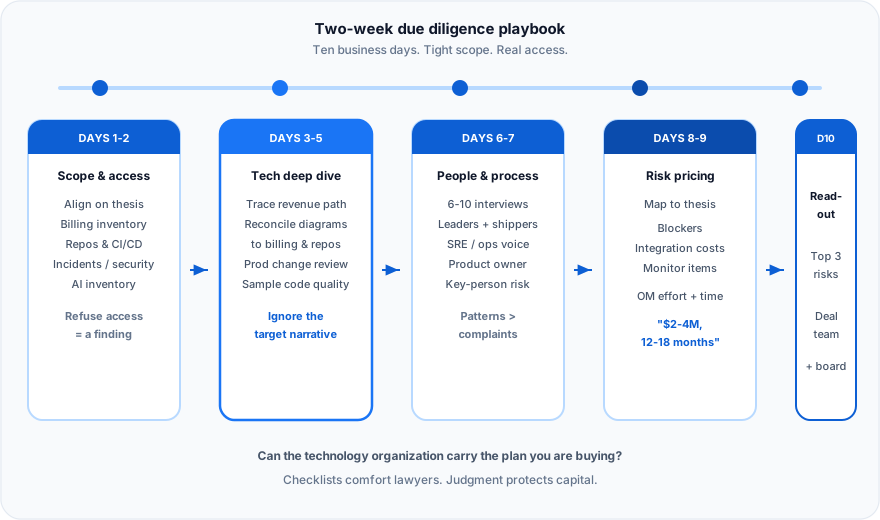
The Two-Week Due Diligence Playbook
A focused review can produce actionable findings in ten business days if scope is tight and access is real. This is the cadence I use.
Days 1–2: Scope and Access
Align with the deal team on the investment thesis and integration plan. What must be true about technology for this deal to work—cost takeout, platform consolidation, faster product velocity, regulatory readiness?
Request access in writing:
- Read-only cloud billing and resource inventory (last twelve months)
- Source repositories, CI/CD configuration, and deployment history
- Architecture and runbook documentation—then verify a sample against production
- Org chart, headcount by function, contractor and vendor contracts
- Incident and security records (twelve months minimum)
- AI tool usage, model inventory, and any governance policies
If the target refuses meaningful access, that is a finding.
Days 3–5: Technical Deep Dive
Work independently of the target’s narrative:
- Trace a revenue-critical path from user action to data persistence. Note single points of failure, undocumented dependencies, and environment drift.
- Reconcile architecture diagrams to billing and repos. Orphaned resources, duplicate services, and “temporary” infrastructure show up here first.
- Review last six months of production changes. Frequency, rollback rate, and who approved them reveal operational maturity.
- Sample code quality and test coverage on core services—not vanity metrics on peripheral repos.
Days 6–7: People and Process
Confidential interviews with six to ten people: two senior leaders, three to four engineers who ship weekly, one operations or SRE voice, one product owner. Ask what keeps them up at night, what would break if key people left, and what they would fix first with unlimited time.
Patterns in these conversations matter more than individual complaints.
Days 8–9: Synthesis and Risk Pricing
Map findings to the investment thesis. Categorize each issue:
- Blockers — Must be resolved or priced before close; may warrant walk-away.
- Integration costs — Known work with estimable effort (e.g., identity consolidation, cloud rationalization, team augmentation).
- Monitor — Real but manageable post-close with clear ownership.
Attach order-of-magnitude effort and calendar time, not false precision. “$2–4M and 12–18 months to reach a maintainable platform” is more useful than “medium risk.”
Day 10: Readout
Present to the deal team and, when appropriate, the board. Lead with the three findings that most affect the thesis. Provide the full assessment as a written deliverable (see below). Separate facts from judgment; label assumptions.
What the Written Assessment Should Contain
A useful report is executive-readable and engineering-defensible. Include:
- Executive summary (one page). Verdict on technology fitness for the thesis, top three risks, recommended price or timeline adjustments.
- Current state snapshot. How the organization actually builds, deploys, and operates—not aspirational state.
- Findings by category with severity, evidence, and business impact.
- Integration effort estimate. Phased view: first 90 days, first year, steady state.
- Key-person and retention risk.
- AI and data posture as a distinct section—not folded into generic “security.”
- Recommended conditions — escrow triggers, retention packages, post-close leadership hires, or deferred milestones tied to technical remediation.
Avoid ranking vendors or recommending a “better” stack unless the thesis requires it. The acquirer’s job is to decide whether to pay for the fix, not to redesign the company on slide thirty-four.
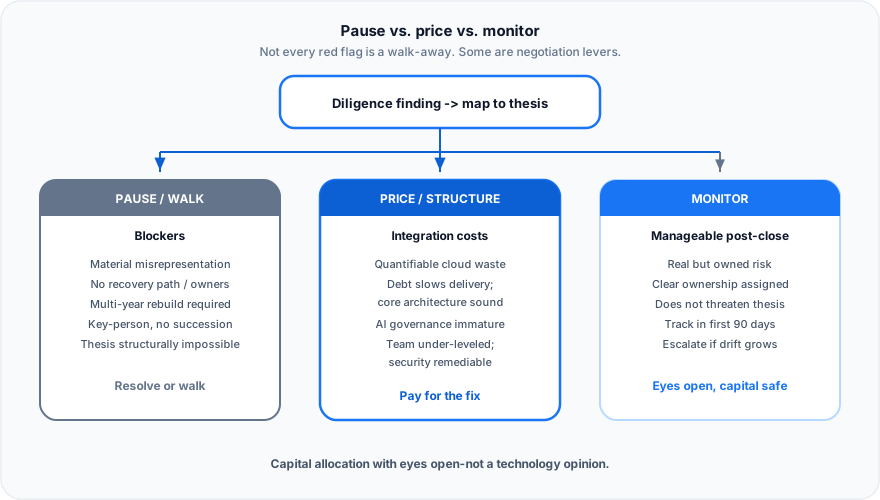
When to Pause the Deal vs. Price the Risk
Not every red flag is a walk-away. Some are negotiation levers. The distinction matters.
Consider pausing or walking away when:
- Material misrepresentation between disclosed and observed state (architecture, security, or AI usage)
- Revenue-critical systems with no credible recovery path and no owners
- Regulatory or customer-contract obligations that cannot be met without a multi-year rebuild
- Key-person concentration where retention is unlikely and no succession exists
- Integration thesis requires platform capabilities the organization structurally cannot deliver (e.g., real-time consolidation of five billing systems with no API layer and no engineering capacity)
Price the risk or structure the deal when:
- Cloud waste and architectural sprawl are significant but quantifiable—FinOps and platform guardrails can recover margin over 12–24 months
- Technical debt slows delivery but core product architecture is sound
- AI governance is immature but not yet embedded in customer-facing revenue paths
- Team is capable but under-leveled; fractional or interim technical leadership can bridge the gap during integration
- Security gaps are real but remediable with funded program work in the first year
The goal is not a technology opinion. It is a capital allocation decision with eyes open.
Conclusion
Technical due diligence earns its fee when it changes what the deal team does—not when it produces a forty-page appendix nobody reads. The acquirers and boards that avoid expensive surprises ask whether the technology organization can execute the plan they are buying, verify that answer against production reality and the people who ship, and translate findings into price, structure, or walk-away.
Checklists comfort lawyers. Judgment protects capital. In a market where every target claims modern cloud, AI-powered product, and engineering excellence, the difference is knowing which questions expose the gap between the deck and the datacenter—and having the experience to know what the answers cost to fix.
Preparing for an acquisition, need technical due diligence, or advising a board on integration risk? Connect with me on LinkedIn to continue the conversation.
Related insights
The Fractional CTO Playbook: When and How to Deploy Executive Leadership Without Full-Time Overhead
When fractional technical leadership makes sense, how to scope engagements for measurable impact, and frameworks for onboarding, leverage, and lasting value—drawn from 25+ years of software, product, and executive leadership.
Measuring AI-Assisted Engineering: The Metrics That Matter (and the Ones That Lie)
License counts and anecdotal speedups do not prove AI adoption is working. An executive framework for baselines, outcome metrics, review burden, platform-fit signals, and governance—so leaders know whether AI is changing economics or just accelerating the wrong architecture.
Leadership Lessons from Law Enforcement: Crisis Management for Technology Executives
What 16 years as an auxiliary police officer taught me about leadership, crisis management, and decision-making under pressure. How law enforcement principles translate to technology executive leadership.