The Fractional CTO Playbook: When and How to Deploy Executive Leadership Without Full-Time Overhead
When fractional technical leadership makes sense, how to scope engagements for measurable impact, and frameworks for onboarding, leverage, and lasting value—drawn from 25+ years of software, product, and executive leadership.
In today’s environment, many organizations face a gap: they need seasoned technical judgment for critical platform modernizations, AI adoption, or delivery transformations—but they don’t want (or can’t justify) the cost and commitment of a full-time CTO or VP of Engineering.
Fractional technical leadership fills that gap. It brings executive-level strategy, risk management, and execution oversight without permanent headcount. Over 25+ years building engineering teams, shipping products, and leading transformations—including a $14M annual cloud savings migration with zero downtime—I’ve seen firsthand how this model multiplies impact when done right.
When Fractional CTO Leadership Makes Sense
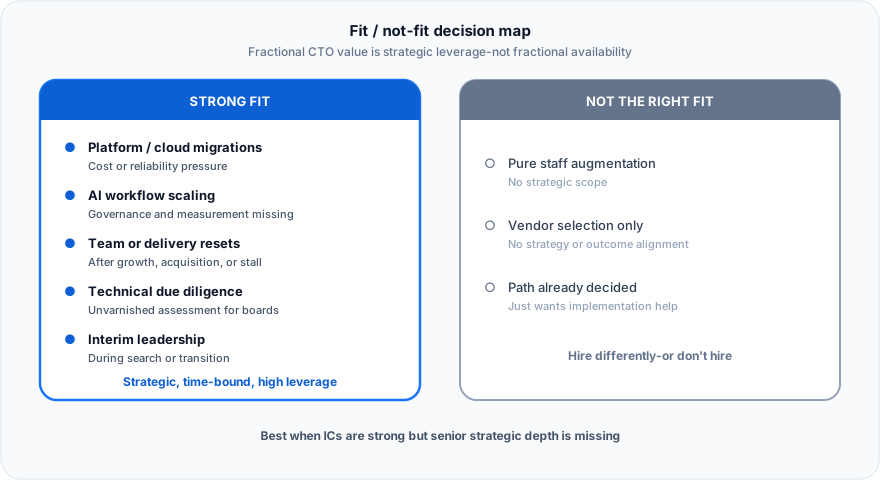
Not every situation calls for fractional support. The highest-value fits include:
- Platform or cloud migrations under cost or reliability pressure
- AI workflow scaling where governance, standards, and measurement are missing
- Team or delivery resets after growth, acquisition, or stalled initiatives
- Technical due diligence for investors or executive teams needing an unvarnished assessment
- Interim leadership during a search or transition
It works best for organizations that have strong individual contributors or mid-level leaders but lack senior strategic depth on complex, high-stakes decisions.
Red Flags: When It’s Not the Right Fit
- Pure staff augmentation without strategic scope
- Vendor selection without strategy or business outcome alignment
- Situations where leadership has already decided the path and just wants implementation help
Scoping Engagements for Maximum Impact
Clear scoping prevents scope creep and ensures measurable value. Key elements of a strong engagement charter:
Business outcomes first — Tie work to specific results (e.g., cloud cost reduction targets, delivery velocity multipliers, risk reduction in AI agent deployment).
Time commitment — Typically 10–20 hours/week for 3–9 months. Define core days or blocks for deep work.
Success metrics — Define upfront: platform adoption rates, cost savings achieved, team feedback scores, or successful production rollout of new workflows.
Access and authority — Fractional leaders need direct access to engineering teams, architecture decisions, and executive stakeholders. Codify this in the agreement.
Knowledge transfer plan — Build in structured handoff from day one.
In the $14M savings migration, early scoping on risk tolerance and zero-downtime requirements shaped every technical decision. That same discipline applies to fractional engagements: define constraints and outcomes before execution begins.
Transition and Onboarding Framework
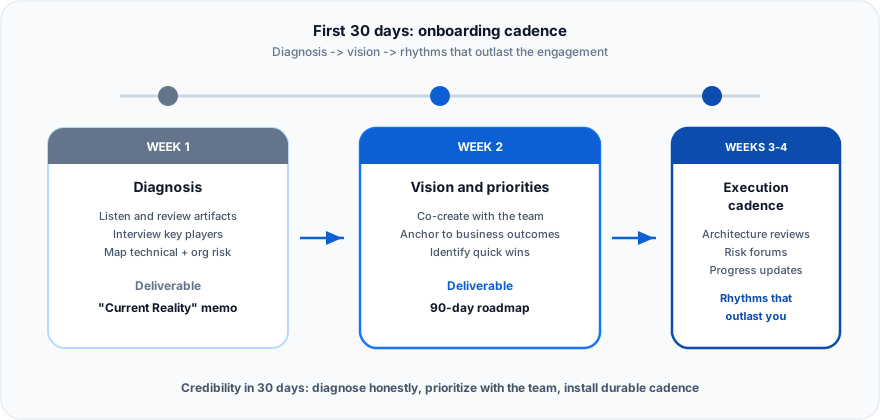
A structured first 30 days builds credibility fast.
Week 1: Diagnosis
Listen, review artifacts, interview key players. Produce a concise “Current Reality” memo that captures technical state, organizational dynamics, and the highest-risk gaps.
Week 2: Vision and Priorities
Co-create a 90-day roadmap with the team. Focus on quick wins to build momentum while keeping the roadmap anchored to business outcomes.
Weeks 3–4: Execution Cadence
Establish rhythms—architecture reviews, risk forums, progress updates—that outlast your engagement. Use small end-to-end teams where possible to accelerate progress while modeling high-performing structures.
Multiplying Impact Across Multiple Organizations
The real power of fractional work comes from pattern recognition across contexts. Lessons from one engagement—for example, AI governance standards that prevent agent sprawl—transfer directly to others.
Practices that amplify leverage:
- Maintain a personal playbook of frameworks, decision matrices, and templates
- Use hands-on credibility—shipping products like QuikGit—to mentor and raise team standards quickly
- Focus on systems and processes that continue delivering value after you step back
Common Failure Modes (and How to Avoid Them)
Poor knowledge handoff — Mitigate with documented decisions, recorded key reviews, and paired sessions with internal successors.
Becoming a bottleneck — Push decision-making down while maintaining visibility on high-risk items.
Cultural mismatch — Spend early time understanding the existing team’s strengths and friction points.
Scope creep into implementation — Stay at the “what and why” level; coach the team on the “how.”
Loss of momentum post-engagement — Build internal ownership and repeatable cadences before you exit.
Leadership lessons from high-pressure environments—like law enforcement crisis response—translate directly here: clear communication under uncertainty, rapid prioritization, and maintaining team trust during change are non-negotiable.
Measuring Success and Ensuring Lasting Value
True ROI shows up in:
- Sustained platform improvements and cost/reliability gains
- Faster, higher-quality delivery post-engagement
- Stronger internal technical leadership capability
- Team retention and confidence in the direction
End every engagement with a Future-Proofing workshop that equips the team to handle the next wave of challenges independently.
Conclusion
Fractional technical leadership isn’t about replacing full-time roles—it’s about injecting battle-tested judgment exactly where and when it’s needed most. Organizations that use it strategically gain executive leverage without the overhead, while leaders get to focus impact across multiple high-stakes environments.
Want to discuss fractional technical leadership, platform modernization, or AI adoption? Connect with me on LinkedIn to continue the conversation.
Related insights
Technical Due Diligence for Acquirers and Boards: What a Real Technology Review Looks Like
Most technology due diligence is a tool checklist that misses integration risk. An executive framework for what actually predicts post-acquisition failure—cloud debt, delivery collapse, AI governance gaps, and platform maturity—and how to run a two-week review that informs the deal.
Leadership Lessons from Law Enforcement: Crisis Management for Technology Executives
What 16 years as an auxiliary police officer taught me about leadership, crisis management, and decision-making under pressure. How law enforcement principles translate to technology executive leadership.
Own Your Destiny: Why AI Makes Vendor Default Obsolete
There is no better time to tackle tech debt and vendor decisions. AI and open platforms are making rented SaaS and contracted code optional again—if leadership still has skin in the runtime.