Agentic Threats Have Changed the World
It is time to stop what you are doing and enable the rapid catch-up before impact. Put a plan in place to tighten that notice-to-fix cycle and keep it going. Then get back to work on other things. The impact and the blast radius are not worth the delay.
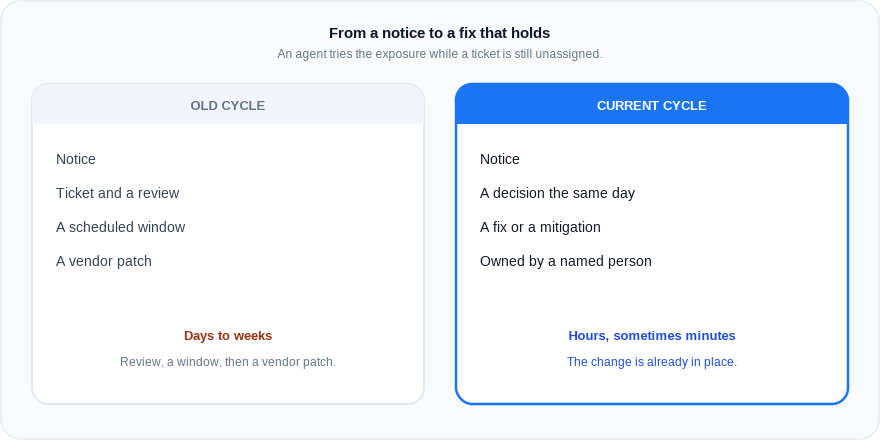
The fixes I have been landing close in hours. Some of them close in minutes. A notice arrives, I decide what has to change, and the change goes in. That is the cycle on the systems I operate.
An agent will try the exposure while a ticket is still sitting with no owner. Finding targets and doing real damage costs almost nothing, takes no human time, and takes seconds or minutes. A weekly board that collects these notices is looking at a list an agent has already had days to try.
Read the notice that shows up before a CVE
I still read CVEs. The notices I act on arrive earlier. A behavior at the edge of a system. A package that changed. A report from someone who builds the component, or from someone who breaks it. A comment from the vendor that is not a bulletin yet.
Sources that arrive before a CVE are becoming the input I use for the first move, because they exist inside the hours I actually have. A CVE gives the problem a catalog name after it is known well enough to file. I put the early source in the same queue as the advisory. A named person accepts it or rejects it the day it arrives. Accept means a production change is already in motion. Reject means we wrote down why it is noise. The identifier, once it is published, confirms the change we already made.
Write the fix when the vendor cannot
The owners and vendors of the tooling, the packaging, and the software cannot keep up. I have had to figure the fix out myself, or build a mitigation, because nothing upstream was going to ship while the exposure was still open. Some of those components sit with a small project. Some sit with a company whose release train was built for a quarter.
Figuring the fix out means reading what the component actually does in our environment and choosing the smallest change that closes the exposure. Building a mitigation means running a control we wrote, with a date to take it back out, until an upstream fix is real. The last time the upstream fix was missing, the mitigation closed the exposure. The vendor patch, when it came, replaced that mitigation.
I have made the ownership point about rented platforms in Own Your Destiny. Renting the software leaves the outcome with the operator. Here the outcome is a mitigation you build before the vendor moves.
The upgrade is where the agent looks
Organizations are replatforming and upgrading right now to catch up on tech debt. I have run that work. A team of about thirty told leadership that a mixed hypervisor estate could only be relicensed. It moved in about four weeks. Relicensing Was a Skills Problem is that engagement.
The move was the right work. While a move like it is in progress, the estate is two versions at once. The old one is still serving. The new one is unfinished. A control that held on the last platform is a plan on the next one. Temporary exceptions stay up.
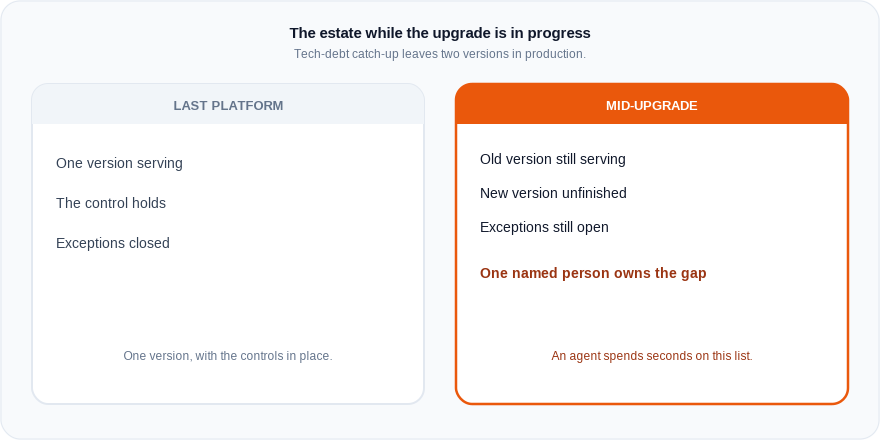
An agent will work that list the same day an exception goes in. I name one person who owns the gap until the move is finished, and I keep the gap to days.
What I change
On the systems I am responsible for, that plan is four moves.
- Take this class of notice off the weekly board. The person who can judge it and land the change is available the day the notice is real. When the exposure is already being tried, the change lands inside the hour.
- File the early source next to the advisory. A behavior, a package that moved, or a report that is not a bulletin yet gets a yes or no from a named person before the day ends. The CVE entry updates the record after the change.
- Authorize a mitigation the operator writes. The operator can remove reachability, constrain the component, or replace it, and writes down the change so a later vendor patch can land on top of it.
- Name the owner of each upgrade gap. Every system that is mid-move has a person who can say what is still exposed and close it. On Monday I check that those names are filled, and I check which notices from the week sat waiting on a vendor.
Related insights
The Token Bill Is the New Cloud Bill: When Nobody Owns Consumption
AI seats were a project. Agent loops are an operating cost. An executive model for token fat tails, hard-cap rationing, cost per completed owned outcome, and why platform teams—not a monthly invoice—must own the meter.
The Review Bottleneck: When AI Writes Faster Than Humans Can Own the Contract
AI did not remove the human constraint—it moved it from typing to review, and it thinned product ownership of the ask and the outcome. An executive model for review capacity, contract review versus style review, shipping too fast, and when to add gates instead of more senior reviewers.
Own Your Destiny: Why AI Makes Vendor Default Obsolete
There is no better time to tackle tech debt and vendor decisions. AI and open platforms are making rented SaaS and contracted code optional again—if leadership still has skin in the runtime.